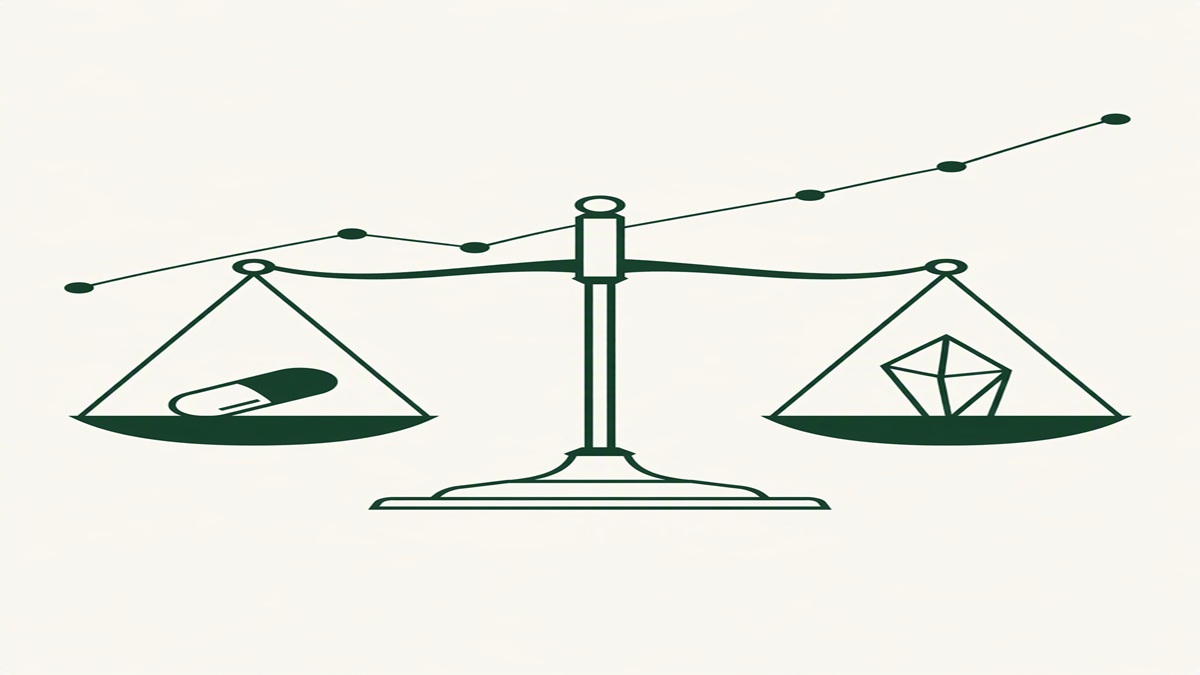
In April 2013, India's Supreme Court told one of the world's biggest drug companies that it could not have a patent on a version of its own cancer drug. Novartis was not claiming it had invented imatinib again. It wanted protection on one crystal form of imatinib's salt, a form it said was better. The Court's answer is now the most quoted idea in Indian drug patent law: better how, and where is the proof?
If you have heard "Section 3(d)" mentioned in class and nodded along, this case is the reason it matters.
A drug India could not patent
Imatinib was developed in the early 1990s by Jürg Zimmermann at Ciba-Geigy, which later became part of Novartis. It works by blocking the BCR-ABL protein that drives chronic myeloid leukaemia (CML), instead of killing dividing cells across the body like older chemotherapy. When the US FDA approved it in 2001, it changed what a CML diagnosis meant. It is on the WHO list of essential medicines.
India, however, was not giving product patents on medicines at that time. Under the Patents Act of 1970, you could patent a process for making a drug, but not the drug itself. That began to change when India joined the WTO and agreed to bring its law in line with TRIPS, with a transition period that ended on 1 January 2005. During the transition, India had to run a "mailbox", a system for receiving pharmaceutical product patent applications and holding them unexamined until 2005.
The problem for Novartis was timing. According to Sivaramjani Thambisetty's analysis, imatinib itself was invented too early to ever enter that mailbox. So Novartis went after something different: a later, refined version of the molecule. This is the same rule that explains why Indian generic companies like Ranbaxy could copy global molecules for decades.
What Novartis actually applied for
Imatinib in its basic form is called the free base. Novartis combined it with methanesulfonic acid to make imatinib mesylate, a salt, and then crystallised that salt into a specific shape called the beta crystalline form. That is the form sold as Glivec. Novartis filed for it in Switzerland in July 1997 and in India's mailbox in July 1998.
Novartis said the beta form was better than the alternatives. It flowed better during manufacturing, was more stable, and absorbed less moisture. Its experts also claimed a 30 per cent increase in bioavailability compared with free-base imatinib.
In 2003 India granted Novartis exclusive marketing rights while the application was pending. Glivec was priced at Rs 1,20,000 a month. Indian generic makers sold imatinib for a fraction of that.
Section 3(d) in plain English
When India finally allowed medicine patents in 2005, Parliament added a safeguard. Section 3(d) says that a new form of a known substance is not an invention unless it shows enhanced efficacy. The Explanation attached to it says salts, polymorphs, isomers, particle sizes and similar variations are treated as the same substance unless they differ significantly in properties with regard to efficacy.
The target is "evergreening": filing patent after patent on small tweaks to a drug to keep a monopoly going. The Supreme Court later noted that during the parliamentary debates, Section 3(d) was the provision the government pointed to when it was asked how the amendment would prevent abuse. The wording of the Explanation, according to Shamnad Basheer, closely resembles a European generic-drug regulatory directive, not a patent law.
The original patent on a molecule expires after 20 years and cannot be renewed. Evergreening is the attempt to delay generic competition with secondary patents on salts, crystal forms or dosage tweaks. Scholars disagree on how much damage it really does, but the worry is real when the new form is the only one doctors can actually prescribe.
Four forums, fifteen years
Novartis's application met five pre-grant oppositions, including from NATCO and the Cancer Patients Aid Association. On 25 January 2006 the Chennai Patent Office rejected it on four grounds: it was anticipated by the Zimmermann patent, it was obvious, it failed Section 3(d), and the claimed priority date was wrong.
Novartis then went to the Madras High Court and argued that Section 3(d) was unconstitutionally vague and violated TRIPS. On 6 August 2007 the High Court rejected both arguments. It said Indian courts could not strike down a law for breaching a treaty India had not written into its own law, and that TRIPS disputes belonged at the WTO. Novartis did not appeal. That matters, because it means the Supreme Court never ruled on constitutionality or TRIPS compliance. People get this wrong all the time.
In 2009 the Intellectual Property Appellate Board (IPAB) partly agreed with Novartis. It found the beta form novel and non-obvious, and accepted its Swiss priority date. But it held that a 30 per cent bioavailability gain is not "therapeutic efficacy" and rejected the product patent under Section 3(d). Both sides appealed to the Supreme Court.
What the Supreme Court decided about this pharmaceutical patent
On 1 April 2013, Justices Aftab Alam and Ranjana Desai dismissed Novartis's appeals. The main findings:
Section 3(d) is a real second hurdle. The Court said it sets up a "second tier of qualifying standards" for chemical and pharmaceutical substances, designed to leave the door open for true inventions while checking repetitive patenting.
Imatinib mesylate was already known, and so was its efficacy. The Court pointed to the Zimmermann patent, which disclosed methanesulfonic acid as a salt-forming option, and to Novartis's own FDA application showing trials in 1,234 CML patients. So the beta crystalline form had to show enhanced efficacy over imatinib mesylate.
Novartis's data compared the wrong things. Its bioavailability study measured the beta form against free-base imatinib, not against the mesylate salt that came before it.
Efficacy means therapeutic efficacy. For a drug meant to cure a disease, the Court held that efficacy can only mean therapeutic efficacy, the actual healing effect. Better flow, stability or moisture resistance did not count. On bioavailability, the Court said that whether it leads to better therapeutic efficacy must be specifically claimed and established by research data.
What the Court did not decide
This is the part most summaries skip.
The Court did not rule on whether Section 3(d) is constitutional or TRIPS-compliant, because the Madras High Court had already dealt with those points and Novartis did not appeal. It did not decide whether the beta form involved an inventive step; it said there was no need to go into that. And it did not say higher bioavailability can never qualify. The judgment is also not a blanket ban on improving existing drugs: it expressly says the door stays open for genuine inventions.
The numbers
The price gap was large. The Supreme Court recorded Rs 1,20,000 a month for Glivec during the exclusive marketing period. A 2004 BMJ figure cited by Linda Lee puts Indian generic imatinib at roughly a tenth of that. The New York Times reported in 2012, as cited by Dorothy Du, that the US price was about $70,000 a year while Indian generics cost around $2,500. For more on how these gaps arise, see how drugs are priced in India.
Novartis also ran a patient assistance programme, GIPAP, giving imatinib free to eligible patients. But Lee, citing a 2003 New York Times report, notes that Novartis began its Indian donations with a warning that they would stop if generics launched. Sources disagree on how far generics were actually stopped after 2003, so treat that part of the story with care.
After the judgment, because imatinib's free base was never patented in India and the beta form was refused, Indian generic makers stayed free to manufacture and export imatinib.
What critics still say
Dorothy Du and Kevin Tarsa argue that "therapeutic efficacy" is too narrow. It leaves out improvements like fewer side effects, heat stability for tropical storage, or turning an injection into a tablet. They also say the Court's evergreening comparison was unfair, because free-base imatinib was never something patients could be given as a tablet. Thambisetty argues that Section 3(d) should have been treated as part of the "person skilled in the art" inventive-step test, not as a separate eligibility bar, which she says leaves it more exposed on TRIPS Article 27.
There is also a practical worry about paragraph 189: how much clinical data is enough, and do you need expensive human trials years before you can even get a patent?
On the other side, the multinational industry (the US body PhRMA and India's OPPI) argued the ruling would discourage companies from launching improved versions in India. Indian generic makers and patient groups argued the opposite.
What happened after
The case still shapes Indian drug patent fights. In the Delhi High Court's dapagliflozin dispute (AstraZeneca v Intas, 2021), the defendants invoked Novartis's point that there should not be a vast gap between what a patent covers and what it discloses. You will recognise the same genus-versus-species instinct in the Ozempic case, even though that one was decided on obviousness grounds, not Section 3(d). And the layered-patent playbook that Section 3(d) tries to limit is exactly what companies used to extend blockbusters like Lipitor.
The Glivec case did not say new versions of old drugs can never be patented in India. It said that if you want a patent on a new form of a known drug, you must show the new form actually works better in the patient, with data. For a company, that moves the burden from paperwork to proof, and it is why Section 3(d) is the first thing an Indian patent examiner checks on a secondary pharmaceutical patent.
What this means for you
If you are heading into regulatory affairs, IP, a generics company or even brand strategy, this is the case that will come up. Three questions to carry with you: is it a new form of a known substance, what exactly is the "known efficacy", and what evidence shows enhanced therapeutic efficacy over the immediate predecessor, not just over something older? Interviewers in IP and regulatory roles like the difference between novelty, inventive step and Section 3(d), because most people blur them.
It is also a reminder of how patent law and pricing meet. The same system that decides who can make a medicine also decides what it costs, and a pharmaceutical patent decision in a courtroom ends up on a patient's monthly bill.
Quick answers
What is Section 3(d) of the Indian Patents Act?
Section 3(d) says a new form of a known substance, such as a salt, polymorph or isomer, is not an invention unless it shows enhanced efficacy over the known substance. It was added to the Patents Act in 2005 to stop evergreening, where companies file repeated patents on small changes to a drug to extend their monopoly.
Did the Supreme Court ban patent evergreening in the Glivec case?
Not in those words. On 1 April 2013 the Supreme Court held that Section 3(d) sets a second tier of qualifying standards for pharmaceutical products, designed to stop repetitive patenting while keeping the door open for genuine inventions. It rejected Novartis's patent on the beta crystalline form of imatinib mesylate but did not ban improvements to existing drugs.
Did the Supreme Court rule on whether Section 3(d) complies with TRIPS?
No. The Madras High Court dismissed Novartis's constitutional and TRIPS challenges on 6 August 2007, and Novartis did not appeal that decision. The Supreme Court appeal dealt only with whether Novartis's application was patentable.
Why was the Glivec patent rejected in India?
The beta crystalline form was a polymorph of imatinib mesylate, a salt already known from the Zimmermann patent. Under Section 3(d), Novartis had to show enhanced therapeutic efficacy over the known substance, and the Court held its data did not do that. The 30 per cent bioavailability figure was measured against free-base imatinib, not the mesylate salt.
Can higher bioavailability ever satisfy Section 3(d)?
Yes, in principle. Paragraph 189 of the judgment says that whether an increase in bioavailability leads to enhanced therapeutic efficacy must be specifically claimed and established by research data. Higher absorption alone is not enough.
Is it Glivec or Gleevec?
They are the same drug, imatinib mesylate, made by Novartis. Glivec is the name used in India and Europe, and Gleevec is the name used in the United States.
- Lee, L. L. (2008). Trials and TRIPS-ulations: Indian patent law and Novartis AG v. Union of India. Berkeley Technology Law Journal, 23(1), 281–313. JSTOR
- Du, D. (2013). Novartis AG v. Union of India: "Evergreening," TRIPS, and "Enhanced Efficacy" Under Section 3(d). Journal of Intellectual Property Law, 21, 223.
- Tarsa, K. (2016). Novartis AG v. Union of India: Why the Court's Narrow Interpretation of Enhanced Efficacy Threatens Domestic and Foreign Drug Development. Boston College International & Comparative Law Review, 39, 40.
- Srivastava, S. (2023). The Indian Patent (Amendment) Act, 2005 and Its Implication on Pharmaceutical Industry, in reference to Novartis vs. Union of India. International Journal of Legal Science and Innovation, 5(4), 51–64.
- Thambisetty, S. (2014). Novartis v. Union of India and the Person Skilled in the Art: A Missed Opportunity. DOI
- Novartis AG v. Union of India and Others, (2013) 6 SCC 1 (Supreme Court of India, 1 April 2013).
If this was useful, the next piece worth reading is on Ozempic's patent expiry in India — a more recent Indian court fight over layered patents, decided on a different legal ground than the one covered here.